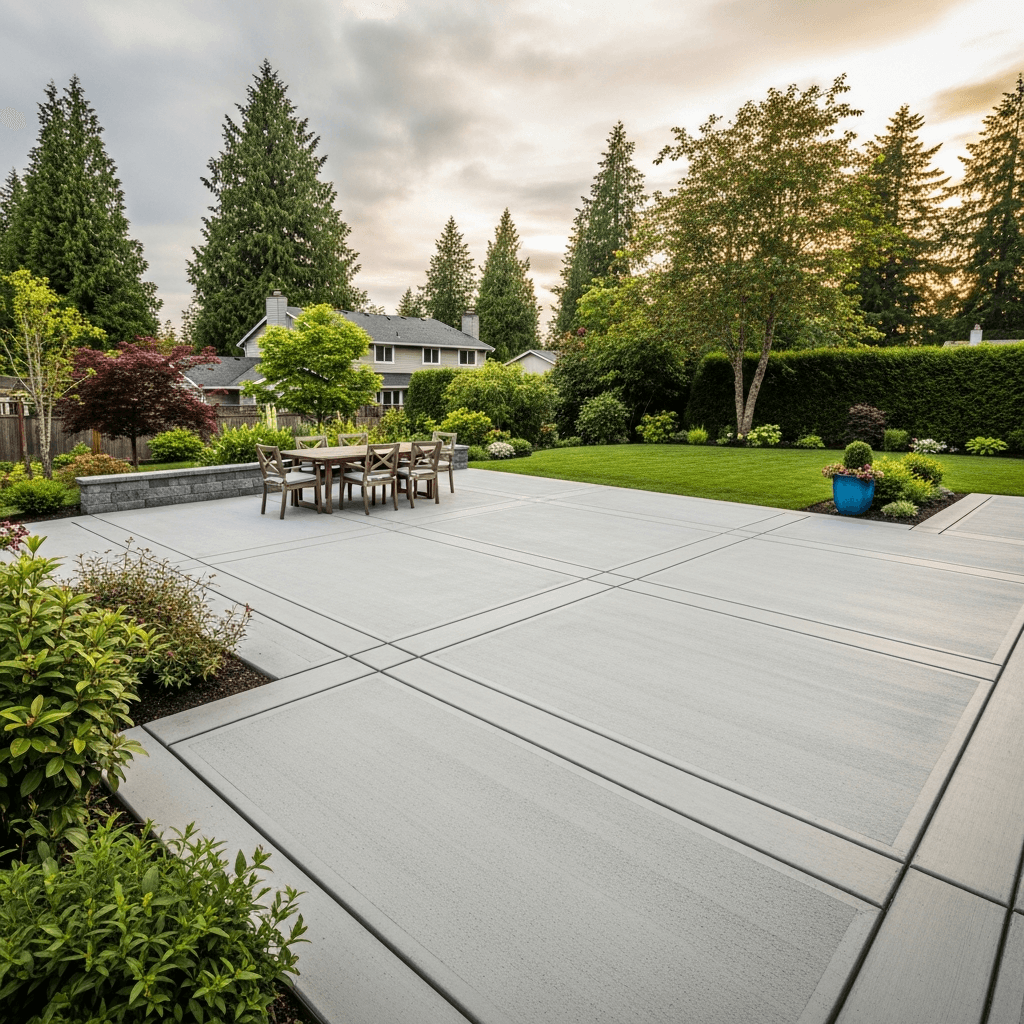
A standard concrete driveway in BC's Lower Mainland typically costs between $8 and $18 per square foot, depending on the finish, site conditions, and access. For a typical two-car driveway (400–600 sq ft), that puts the total roughly between $3,200 and $10,800.
But that range is wide for a reason. The difference between an $8 driveway and an $18 driveway isn't just the finish on top — it's what's happening underneath. And that's the part most quotes don't explain.
What Actually Drives the Price
1. Demolition & Removal
Replacing an existing driveway? The old slab needs to be broken up, loaded, and hauled to a disposal facility. Cost depends on thickness, whether it's reinforced, and how much area needs to come out. Thicker slabs and reinforced concrete take more equipment and time.
2. Base Preparation
This is where cheap quotes cut corners. A proper base in the Lower Mainland means 6–8 inches of compacted gravel, graded for drainage, on stable subgrade. If your soil is clay-heavy (common in Surrey, Langley, and Coquitlam), you may need additional excavation and drainage rock.
Skipping base prep is the single fastest way to get a cracked driveway. The concrete itself is strong — it's the ground underneath that moves.
3. Concrete Supply & Delivery
Ready-mix concrete is ordered from a supplier and delivered by truck. The cost depends on the PSI rating, whether air entrainment is specified (standard in the Lower Mainland for freeze-thaw resistance), and the volume ordered. Suppliers charge minimum load fees — smaller pours can cost more per cubic meter because of this.
If the truck can't reach the pour site directly, a pump truck is required to move the concrete from the street to the forms. Pump trucks add a significant line item to the project, but they're often the only option for backyard pours or properties with limited access.
4. Access & Grade
Tight access means smaller equipment, more hand-work, and sometimes wheelbarrowing concrete from the street. Steep grades require additional forming and may need retaining elements. Both add labor hours.
5. Reinforcement
Standard driveways use 10M rebar on 24-inch centers or 6x6 welded wire mesh. For heavy loads (RVs, trailers, work trucks), we step up to 15M rebar on tighter centers with a thicker slab. More steel means more material and more labor tying it.
6. Shape & Complexity
A straight rectangular pour is the most efficient. Curves, radius edges, integrated stairs, or decorative borders all increase forming time. Custom formwork for curved driveways can add significantly to the forming labor.
7. Permits & Inspections
Some municipalities in the Lower Mainland require permits for driveway replacement or new driveway construction — especially if it changes the drainage pattern or crosses a sidewalk. Permit fees and required inspections vary by city and add both cost and timeline to the project.