Concrete Patio Cost: Complete Budget Guide for BC Homeowners
By CarverMarch 12, 2026
A concrete patio in BC's Lower Mainland typically costs between $8 and $25+ per square foot, depending on the finish type, base preparation, and site access. A standard 12×12 patio (144 sq ft) runs roughly $1,150 to $3,600+. A larger 20×20 space (400 sq ft) lands between $3,200 and $10,000+.
That range reflects the difference between a basic broom finish slab poured on flat ground with truck access — and a multi-color stamped patio in a sloped backyard that needs excavation, a pump truck, and custom forming. Same material, completely different job.
Cost by Finish Type
Finish
Cost / Sq Ft
Best For
Broom Finish
$8 – $11
Utility patios, side yards, budget-conscious projects
California Smooth
$10 – $13
Modern aesthetic, clean lines, contemporary homes
Exposed Aggregate
$12 – $15
Natural stone look, slip resistance, low maintenance
Stamped Concrete
$13 – $25+
Decorative patterns, entertaining spaces, high curb appeal
Disclaimer: The figures above are based on Lower Mainland averages and are intended for educational purposes only. Actual costs vary on a job-to-job basis as material markets move, supply and demand shift, and municipal bylaws change. A free on-site consultation is the only way to get an accurate estimate for your specific project.
How Size Affects Cost
Larger patios generally cost less per square foot — because the fixed costs (forming, mobilization, concrete delivery minimums) spread across more area. But they cost more in total. Here's how common sizes compare:
Patio Size
Broom Finish
Stamped
10×10 (100 sq ft)
$1,000 – $1,300
$1,500 – $2,500+
12×12 (144 sq ft)
$1,150 – $1,600
$1,900 – $3,600+
16×16 (256 sq ft)
$2,000 – $2,800
$3,300 – $6,400+
20×20 (400 sq ft)
$3,200 – $4,400
$5,200 – $10,000+
Disclaimer: The figures above are based on Lower Mainland averages and are intended for educational purposes only. Actual costs vary on a job-to-job basis as material markets move, supply and demand shift, and municipal bylaws change. A free on-site consultation is the only way to get an accurate estimate for your specific project.
What Drives Patio Cost Beyond the Finish
Access & Equipment
Most patios are in backyards — which means the concrete truck can't pour directly into the forms. A pump truck is needed to move the concrete from the street to the backyard. This is a significant additional cost that many homeowners don't anticipate. Narrow side yards, fences, and gates all affect how materials and equipment get to the pour site.
Excavation & Base Prep
Every patio needs a compacted gravel base for proper drainage and to prevent settling. In areas with clay soil — common in Surrey and Coquitlam — the excavation goes deeper and more drainage rock is needed. If there's an existing patio to demolish and remove, that adds to the total.
Grade & Drainage
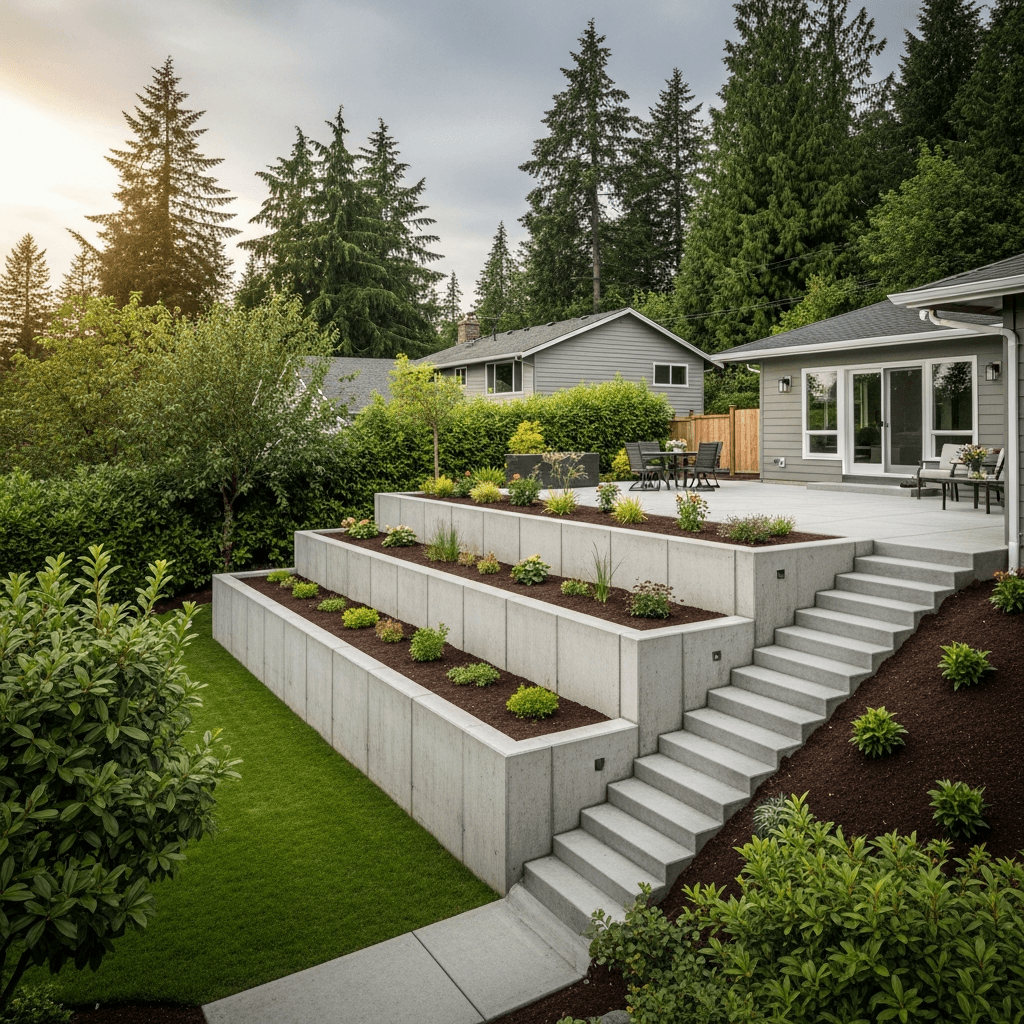
A patio must slope away from your home — typically 1/8 inch per foot minimum. On sloped lots, this may require retaining elements or stepped sections. Proper drainage prevents water from pooling against your foundation and is never optional in the Lower Mainland's climate.
Add-Ons & Integrations
Many patios include integrated features that increase cost but add major value to the space:
Built-in fire pit — requires gas line routing and additional forming
Seat walls or raised planters — adds concrete volume and custom formwork
Steps to different levels — radius or straight, each design has different labor
Decorative borders — stamped or colored border with different center finish
Concrete Supply & Delivery
Patio concrete is ordered from a ready-mix supplier and delivered by truck. The mix design matters — air entrainment is standard in the Lower Mainland for freeze-thaw resistance, and the PSI rating depends on the intended use. Suppliers charge minimum load fees, so smaller pours can cost more per cubic meter.
For backyard patios, a pump truck is almost always required. The concrete is pumped through a hose from the truck on the street to the forms in your backyard. This is a separate line item from the concrete itself and can be a significant cost — but it's unavoidable for most patio projects.
Permits & Regulations
Most standalone patios in the Lower Mainland don't require a building permit — but there are exceptions. If the patio connects to a structure, changes drainage patterns, or includes features like elevated platforms or covered areas, your municipality may require one. We check the specific bylaws for your city before we quote so there are no surprises.
Get Your Free Estimate
Every project starts with a free on-site consultation. We assess your site, discuss your goals, and provide a transparent, itemized estimate.
What Separates a Patio That Lasts
The finish is what you see. The base is what makes it last. A well-built concrete patio starts with proper excavation, compacted gravel base, correct reinforcement, and control joints placed where the concrete wants to crack — not where it looks convenient.
When comparing quotes, look for specific details on base depth, reinforcement type, concrete specification, and drainage plan. A single number with no breakdown is a gamble — you won't know what you're getting until the work is done.
Ready to Start?
Get Your Free Estimate
Tell us about your project and we'll get back to you with a free, no-obligation estimate. We service the entire Lower Mainland.